The story behind the name

Vinda·flow

Bridging ancient wisdom and modern hydraulics. The name is a deliberate synthesis: an Indo-Iranian root for finding and safeguarding life, joined to the central word of hydraulic science.

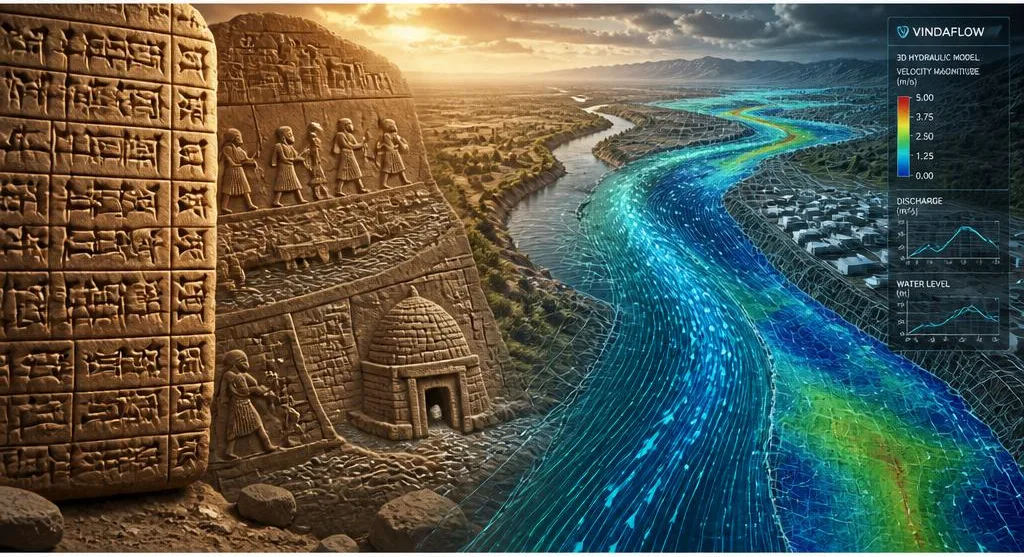
Ancient cuneiform tablets and stone reliefs on the left dissolving into a modern 3D hydraulic flow simulation of a river basin on the right.
From the clay record to the computed river — conceptual illustration

The origin of “Vinda”

One syllable, two inheritances

Ancient Avestan · Old Persian

vind-

vinasti · vindati

to discover · to find · to safeguard

An Indo-Iranian root carrying the act of finding — and, with it, the act of keeping safe what was found. It is the verb of the one who sees what is coming and secures life against it.

Old Norse

vinda

to wind · to twist

the turning, meandering path

The same syllable, far to the north, describes winding and twisting — the very motion a river makes as it carves its way through complex terrain.

The oldest flood record

Gilgamesh, and the survivor named for wisdom

The Mesopotamian flood story survives in three languages across roughly a thousand years — and in every version the man who lives is defined by what he knew and what he found, not by who favoured him.

Ziusudra

Sumerian · Eridu Genesis

“life of long days”

The oldest surviving name of the flood survivor, king of Shuruppak on the Euphrates.

Atra-hasīs

Old Babylonian · c. 1700 BCE

“exceedingly wise”

Here the survivor is not named for luck or favour. He is named for the faculty that saved him.

Ūta-napištim

Akkadian · Gilgamesh, Tablet XI

“he found life”

The same man, renamed for the act itself: he found — and so life continued.

How the warning arrived

In Tablet XI of the Epic of Gilgamesh the gods bind themselves by oath to tell no human what is coming. Ea — the god of wisdom — keeps the letter of that oath and breaks its spirit: he does not address the man. He addresses the reed wall of the man’s house, knowing who is listening on the other side.

“Reed house, reed house! Wall, wall!”

— Ea to the wall of Utnapishtim’s house, Gilgamesh XI

Strip away the gods and a familiar problem remains: someone knows the flood is coming, and the warning has to reach the person who must act — in time, and through whatever channel is available. Four thousand years later that is still the hardest part of an early-warning system, and it is still where they fail.

A specification, not a legend

The most striking thing about these tablets, for an engineer, is how practical they are. The Ark Tablet — sixty lines on a piece of clay 11.5 × 6 cm, dated to roughly 1900–1700 BCE and deciphered at the British Museum by Irving Finkel — does not describe a miracle. It issues a build order: a round coracle some 70 m across, its hull braided from palm-fibre rope, stiffened with wooden ribs, and sealed with measured quantities of hot bitumen.

Materials, dimensions, waterproofing, quantities. It is, in every meaningful sense, a bill of materials for a flood-survival structure — the oldest one we have.

An ancient domed stone shelter standing in dark turbulent floodwater, warm light glowing from its doorway.
The shelter that holds — conceptual illustration of the enclosure motif shared by the Var of Jamshid and the Mesopotamian vessel.

And the ground remembers

The record is not only literary. When Erich Schmidt excavated Tell Fara — ancient Shuruppak, the city the texts give as the survivor’s own — he found a thick layer of clay and sand lying directly on the ruins of the Jemdet Nasr period; Leonard Woolley had found comparable deposits at Ur. These are local flood layers, and no serious reading turns them into a single worldwide deluge. What they do show is more useful than a legend: catastrophic river flooding was a recurring, survivable, city-ending reality of the Mesopotamian alluvial plain — frequent enough to be remembered, written down, and engineered against.

Tablet XI reached the modern world in 1872, when George Smith recognised the flood account among the tablets brought to the British Museum from Ashurbanipal’s library at Nineveh.

The Iranian thread

From the Var to the model

East of Mesopotamia the same answer is given twice — first as myth, then as masonry, and now as computation.

  1. Avesta · Vendidad

    Jamshid and the Var

    Warned of a catastrophic winter and the waters that would follow it, Jamshid builds the Var — an enclosure to shelter living beings until the danger passes. Warning first, then an engineered refuge: the same two-part answer, told in Iranian rather than Mesopotamian terms.

  2. Sasanian Iran · 3rd c. CE

    The Shushtar hydraulic system

    Myth becomes masonry. At Shushtar, thirteen dams, weirs, canals, tunnels and mill-races were designed as one system to divide and control the Karun — a scheme UNESCO calls a masterpiece of creative genius, and parts of which still carry water today.

  3. Today

    Computational flow intelligence

    The instruments changed; the task did not. Numerical hydraulics, AI forecasting and spatial analysis now do the reading of the warning — and the design of the refuge.

The power of “Flow”

The universal element of hydraulic science

Flow speaks directly to the technical work: open-channel hydraulics, flood-wave propagation, dam-break analysis, and fluid dynamics. It is the measurable half of the name — the part that can be written as an equation.

Vinda — to find, to safeguard.

Flow — the moving water itself.

Together: the discovery of flow intelligence.

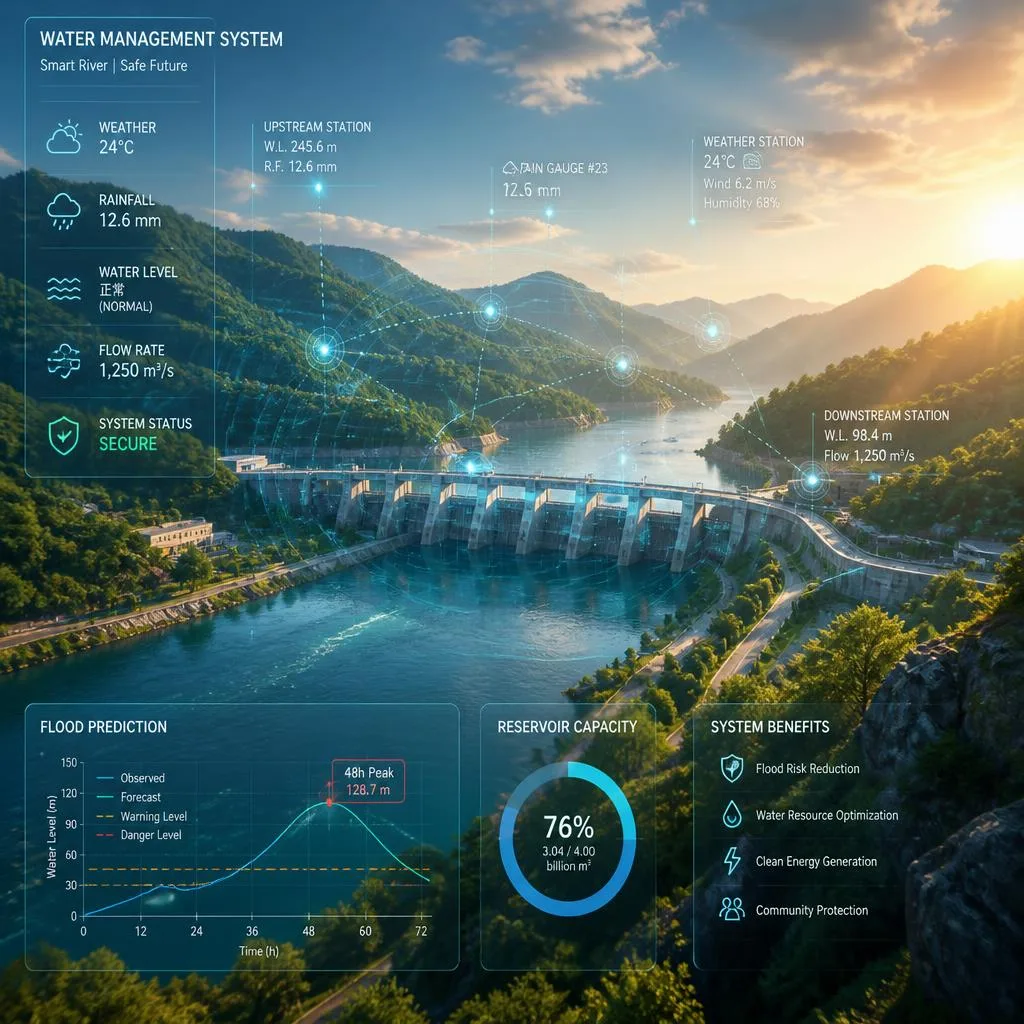
A monitored river valley with a modern arch dam, sensor points and flood-prediction overlays at golden hour.
The instrumented catchment — conceptual illustration

We unite millennia of flood-management lessons with computational modelling, spatial analysis and predictive engineering.

We don’t just study water — we decode its flow, predict its behaviour, and engineer resilient solutions for a safer tomorrow.

See the workAbout the author